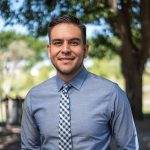
A little military history is pertinent here to understand how caucus member Mark “Pete” Petersen (Army, E-8 ret.) feels about military service. Pete is proud to be the current family member with ancestors who served the American and English military back to the 18th Century. Pete said, “I didn’t want to be drafted because I might have been the first draftee.”
And serve Pete did in the Army, the Army Reserves, and the Texas National Guard, from 1971 to 1999. His dad, a retiree who served in WW II in the Navy and later as a Mustang officer in the USAF, wanted Pete to enlist to be an officer. “I wouldn’t do that,” Pete explained, “because I saw what it did to my mom when he was passed over for promotion to major. There was nothing he could do. I was never going to let that happen to me. I did want to be Command Sgt Major but there was too much politics,” he said.
“Dad had the unique military experience to have served in World War II, the Korean War, and the Vietnam War. He also supported the US in Florida during the Cuban Missile Crisis. He packed in a lot during his service. He was a pilot and he became one of the first nuclear weapons officers,” he said proudly.
Pete grew up as a military brat, attending 11 different schools; his dad was in Iceland when Pete was born. He did not let his address changes diminish his determination to succeed. Scouting was very important to Pete and while he was president of his Explorers Post 59 in Austin, he learned about computing because IBM sponsored his troop. Pete earned enough credits to qualify for early high school graduation but ran up against bureaucracy and did not graduate early. He played golf and ran cross-county in high school until he quit at 16 to get a job to buy his first car.
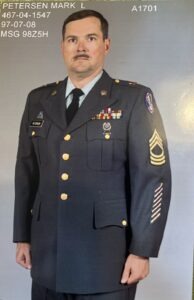
Pete enlisted in the Army right after high school. He served until 1974. “I took the Combat Drivers Course at Camp Bullis, TX. While at Fort Sam Houston TX, I experienced two of the most dangerous situations I ever saw during my service. One night, I heard a shot ~50 yards away. A soldier with whom I’d just shared dinner was shot on post right in front of the barracks, paralyzed by a bullet to his spine. In another occurrence, I saw several medic trainees using syringes in the barracks. After I reported them, I learned they were using them to inject heroin. Drugs were a problem in the military back then,” he said. “I got assigned to the US Army Medical Training Center mail room. I took correspondence courses and completed an OJT training program to become an Army Postal Clerk. I liked working in the mail room and for the First Sergeant so much that I never went back to the medic course. Later in my Army career, I served as an EEO representative, also by appointment; I also hand delivered Congressional Investigation documents to battalion and brigade commanders at the USAMTC. This was an eye-opening experience for a young private,” Pete recalled.
He received orders for Vietnam in 1972 but President Nixon signed the peace accord while he was at home on leave, so he returned to his former company. “My time at Fort Sam Houston included college work at San Antonio College and two promotions. I was picked up by the Army Security Agency (ASA) in October 1973 and left in November for the 7th Radio Research Field Station (RRFS), Ramasun, Thailand. The ASA ordered me to Ramasun as a postal clerk, a position that required a Top Secret clearance. My trip to Thailand was very eventful,” Pete explained.
- “I flew on my first jet airplane, crossed the Pacific landing in Alaska, Japan, and with a one-week layover at Clark Air Base, Philippines.
- After a while, I was promoted to Acting Sergeant in charge of the mail room and later I was responsible for the teletype reports from SR-71 Blackbird reconnaissance aircraft,” Pete said.
“I October 1974, I returned on a charter flight to the world, as we called the US. When we got off the plane at Travis Air Base, we saw demonstrators across the flight line fence, carrying posters and calling us mercenaries and baby killers. Some of the special force soldiers headed for the fence to fight but the Air Force police stopped what might have been an interesting brawl. I later found out Life Magazine ran a story about these demonstrations. I was discharged at Oakland Army Base and returned home,” Pete recalled.
After he got out, he attended UT-Austin and worked as a restaurant manager. “I took every advantage to earn college credits in person and online while I served and after that.” The restaurant job was hard work and long hours, yet he thought a lot about his military service. In 1979, he joined an ASA Army Reserve company in Austin, TX. The Army was increasing readiness and I volunteered to return to active duty for the Army Reserves. While serving in Company D, Defense Language Institute, Presidio of Monterey, CA he became the manager of his company’s golf team that won the post golf tournament.
He remained on active duty in the reserves while serving in Austin and rose to the rank of First Sergeant. He returned to drilling reservist status in 1989. He transferred to the Texas National Guard for a year and retired in 1999.
Pete worked as a special education teacher for 13 years for the State of Texas while serving in the reserves. He took early retirement in 2005 from the state and subsequently worked at the US Dept. of Veteran Affairs for 7 years. He took another early retirement from the VA and started his volunteer work as a service officer.
“Working at the School for the Blind was my favorite job,” he said proudly. He knew he was making a difference. Then he worked at a juvenile detention facility, the Marlin Orientation and Assessment Unit of the Texas Youth Commission. He started training juvenile detention officers who work with incarcerated youth at TYC. Pete spent the next eight years as a special ed teacher. “I did that because I was healthy and strong enough to teach modified martial arts. The staff had no weapons. Only the security staff had pepper spray. It was risky but it was a 9-to-5 job, which I needed at that time. But I enjoyed that job too,” he recounted.
This man had earned retirement benefits from three “employers” – the Army, the State of Texas, and the VA. And he’s still working hard to help those in need. During his time working full-time, he completed three degrees with the assistance of three different GI Bills.
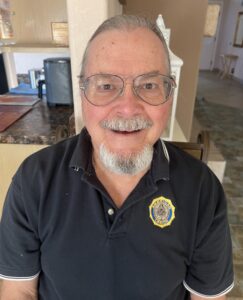
Pete and his family moved to Las Cruces, NM after his wife retired. He volunteered to drive veterans to doctor appointments in a program funded by VA and the Disabled American Veterans (DAV) service organization. He did that for eight years while working as a veteran service officer.
“I joined the American Legion in 2024, which has a mission to help Veterans, their dependents and survivors. So now I help them. I like to tell my vets that I have a practical PhD on the VA. I regularly get referrals from out of state because I have been giving my business cards to folks needing help since about 2006. “Few of our service officers have the experience I have,” Pete bragged.
In his spare time, Pete volunteers to support the Rio Grande Honor Flight (formerly
Honor Flight of Southern New Mexico). “I have been doing service officer work for over
20 years. I plan on doing it until I can’t anymore. My work is joyful. I tell the vets I’m a volunteer. Vets try to pay for things for me and the only thing I’ll take is a cup of coffee,” Pete says with conviction.