Now, you may ask yourself, what does this creative master of music and technology have in common with the members of our caucus?
Panaiotis participated in the design of a decision support tool for the Defense Threat Reduction Agency, and presented a paper titled “Algorithmically Generated Music Enhances VR Decision Support Tool” at the Science and Technology for Chem-Bio Information Systems (S&T CBIS) Conference in October 2005. Through various grants and as part of an interdisciplinary team, Panaiotis engaged in collaborative projects in the Visualization Laboratory at the Center for High Performance Computing at UNM. A notable project with Los Alamos National Laboratory involved network connection analysis.
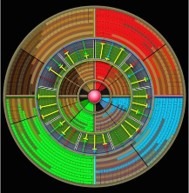 Panaiotis’ visual concept of an interactive decision support tool designed for the Defense Threat Reduction Agency (circa 2006).
EARLY INTEREST IN MUSIC. Panaiotis started simple. He was moved when he listened to the music Puff the Magic Dragon in kindergarten. In the fourth grade, he had his first experience playing an instrument. Choosing the instrument proved to be difficult because Panaiotis was born with a rare birth defect, arthrogryposis multiplex congenita. In his case, he was missing muscles and bone structure from his arms and hands. He had years of painful physical therapy, body casts, and other therapies before a new orthopedic surgeon attempted to increase functionality in his right arm.
“My hands had limited mobility, but I adapted. If I needed to do something, I found a way to do it. I became very creative. I managed most things. I learned to write, I played soccer and ran track and cross country, and participated in marching band, choir, and drama,” he said modestly.
“We moved to Cary, North Carolina when I was halfway through high school. Because the music director of the band and chorus in Cary was only interested in the band, he asked me to direct the chorus because of my choral experience in California.”
FOCUSING ON EXPERIMENTAL MUSIC. After high school, he fed his music appetite, earning bachelor’s, master’s, and doctoral degrees in music. This time in his life was the beginning of many connections with musicians, composers, conductors, and creators of multi-dimensional, interactive works.
“My dissertation at the University of California at San Diego (UCSD) was based on and was part of my first opera: The Akeda. The libretto dovetailed two ancient stories of child sacrifice: Isaac and Abraham, and Iphigenia and Agamemnon. Both children were performed by one singer (Michele Spiro, now my wife) and the two patriarchs by a bass (Phillip Larson). Yaweh, Artemis, and the Greek army were collectively performed by a Greek chorus.
UCSD was a hotbed of experimental music when Panaiotis was there. “I was influenced by many 20th century composers including Bela Bartok, Igor Stravinsky, Charles Ives, Krzysztof Penderecki, John Cage and a wide range of other composers and their works. By the time I met John Cage at UCSD, I had already performed several of his works, among those of many other composers. My wife and I performed at his memorial service in 1992. Music icons such as Yoko Ono took part,” he reflected.
He learned some of his most formative lessons while helping the theater department at UCSD. “I learned to write music while working with the theater department. A lot of master’s theater student directors and faculty came to me to do their sound design and music. I did 24 productions in two years! I learned to compose by writing to meet tight deadlines. That’s also when I started working with the San Diego Public Theater and became their theater sound designer and composer,” he explained.
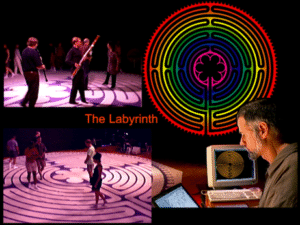 Top left to bottom right:
Relâche Ensemble performing on a 36-foot canvas of the Chartre labyrinth. Colorized Chartre-designed labyrinth. Panaiotis and members of Relâche walking the labyrinth in a rehearsal. Panaiotis manipulating his software during a rehearsal.
“After graduating from UCSD, I moved to New York to collaborate with avant-garde composer Pauline Oliveros at her request. That led to years of eye-opening collaboration. We shared an interest in sound spaces and electronics.
Pauline played an accordion in which the notes on the left side were tuned slightly differently than those on the right,” he explained. “Our performances were all improvised; we had no written music. We considered the whole system (acoustic instruments, electronic processing, and the concert hall) to be one instrument – a duet, each working different parts of the system (the Extended Instrument System). The music changed as we reacted to each other. It was super-focused music making, and we produced a CD in Switzerland, The Roots of the Moment, reflecting this approach to making music,” he recalled.
“Pauline and I drove to a concert in New York City with a new digital processor that was to be used for the concert. I madly read the manual to prepare to perform with it at that evening’s concert. Because the performance was also billed as incorporating a computer with music, but we didn’t have anything related to the computer in our setup, I turned our computer around and showed the audience a screensaver while we performed.”
In 1988, he co-founded the Deep Listening Band with Pauline Oliveros and Stuart Dempster, performing in unique spaces such as a 14‑foot deep underground cistern in Washington, a limestone cave in New York, and a lava cave in the Canary Islands. Later, the Deep Listening Band traveled to Japan to create a five-hour improvisation for one of the final performances in the world-class Panasonic Hall in Japan.
Those early years paved a path of creativity, breaking performance boundaries in the US and abroad. “This was a time when I was doing diverse things with music, including many concerts throughout Europe and the US; the sound design and music for the Hans Otto Theatre production of Death of a Salesman in Potsdam, East Germany; and a complete sound track for a production of The Tempest for the Basel Marionetten Theatre. My dance work The Ballad of Frankie Silver was premiered in Basel by a Swiss dance company that later performed it at the 1996 Olympics,” he said.
BANDOJO. “The development of Bandojo took about 15 years,” Panaiotis reflected. “Actually, I created the music engine that is used in Bandojo while living in upstate New York (circa 1992).” He invented Bandojo in 2020. It is a digital musical instrument designed for players of a wide range of ages, physical and cognitive capabilities, and musical backgrounds. It has been used in the Spinal Cord Injury Unit at the Raymond G. Murphy Department of Veterans Affairs Medical Center and in some schools in the Albuquerque area.
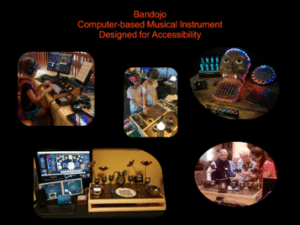 Top left to bottom right:
A young girl plays a version of a Bandojo Touchboard designed for the visually impaired. Two young girls play a version of a Bandojo Touchboard designed and built by Girl Scouts. Halloween-themed Bandojo Touchboard.
Bandojo dinner setting at the Intel Museum in Capertino. A Bandojo event at a retirement home: L to R: Panaiotis’s mother, a resident at the home, Bandojo co-designer Lisa Maynes.
This Author’s Perspective on Bandojo: “A person can create music by exploring all that the Bandojo can do,” Panaiotis said as he introduced his musical marvel to me in his studio. I wasn’t sure I believed him. He said, “Go ahead, explore,” he said as he gave me a basic introduction to the keyboard. I slowly approached the buttons, dials, and colorful, metal orbs laid out in a grid. You need to understand I am a person who loves music, all kinds of music. I love to sing, although most people tell me not to. I marvel at the creations of composers. But never did I think I could create a piece of music – until I explored Bandojo. My fingers magically connected to my brain and found the notes; soothing notes played in a sequence that one could realistically call music. It was the first time I felt capable of doing something worthwhile with music; something people wouldn’t tell me to stop doing. It was then that I could understand the worlds of opportunity that Bandojo could open up in schools, for persons with special needs, for patients in hospitals. Thank you, Panaiotis, for creating a beautiful instrument to help these persons feel whole.
And thank you, Panaiotis, for creating new worlds of music for the world to explore.
Panaiotis’ Thoughts on…..
CONDUCTING: “Certain circumstances pull the energy in, and I perform and project what I want to hear. That becomes more of a mental projection, and the physical body follows in the performance. I can sense when I connect with all the performers in what I am sensing, and the musicians connect with that. That is something all the great conductors have.”
PERFORMING: “I believe there is an energy level that gets communicated in music performance. Performing for me – I often have experiences in performance that transcend the actual performance.”
TEACHING: Panaiotis continues to share his musical gifts with students. “It’s my primary musical outlet now,” he said, mentioning his past world music class at Stetson University and Rollins College in Florida; his five years as a research assistant professor in the UNM Department of Electrical and Computer Engineering and the Department of Music; and his current role as educator for brass at the NM School of Music. “I love that I can meet students’ individual capacity to focus and their level of expertise. I have a wide range of students in age and skill levels,” he said.
RESEARCH: “My work at UNM (2003-2008) included developing VR-based data audio display systems that utilized algorithmically generated music to enhance the comprehension of large data sets and complex systems. Through various grants and as part of an interdisciplinary team, I engaged in collaborative projects in the Visualization Laboratory at the Center for High Performance Computing at UNM. A notable project with Los Alamos National Laboratory involved network connection analysis. These are a few examples where my interest and expertise in music and technology intersected,” he explained.
THE GOLDEN RATIO: “I had looked into the Golden Ratio before but really hadn’t done anything with it. Then a high school student from a family of musicians came to me to learn if the Golden Ratio was used in music. Her interest inspired me to write a piece, Golden proportions No. 1, for her family,” he said. “I applied the Golden Ratio eight levels deep to the time structure, from movement length to phrase length to meter and rhythm.” Since then, he’s written over 20 compositions incorporating the Golden Ratio.
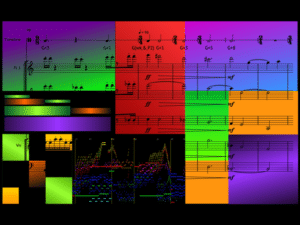
Inside the black frame is a golden rectangle with variable colors and sizes of nested golden ratio rectangle panels. Behind the translucent panels is an excerpt of the music score to Golden Proportions #1 at the golden section of the music, which also coincides with the golden section of the 2nd movement. A colorful graphic display in a bottom rectangle shows the note activity of the opening to the Golden Proportions orchestral work Northern Lights.