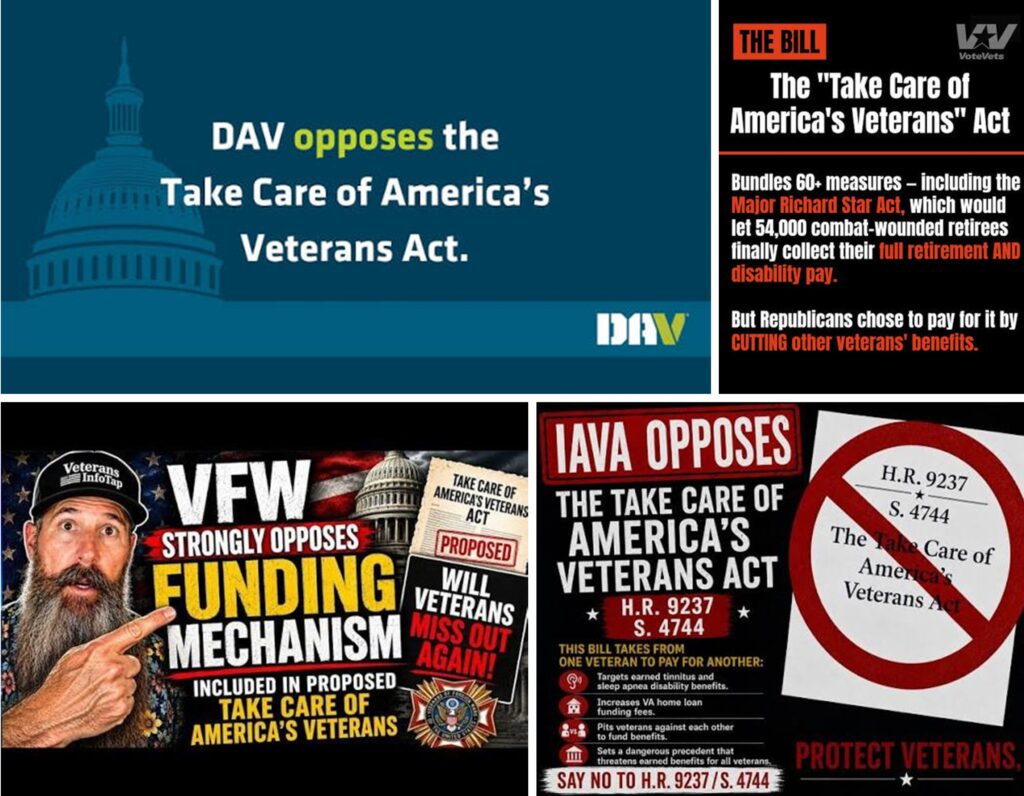
 The Take Care of America’s Veterans Act (TCAVA, HR 9237) is designed to do the exact opposite of what its name implies. We – as Veterans, as members of Veterans’ families, as advocates for Veterans, and as a caucus – must keep this travesty from being enacted into law. National Veterans’ groups and Democratic legislators have already opposed TCAVA. We need to follow their lead. Learn how in TAKE ACTION.
The Background:
- The TCAVA is a legislative priority for House Republicans. It was introduced in the House on June 10. The House Rules Committee cleared it to go to the floor of the House. It was scheduled to be heard last week. Then media outlets gave a lot of attention to Speaker Johnson when he called a recess. The House did recess on June 23, 2026, but the official record indicates that the Speaker announced the recess at that time, not that it was called in advance Office of the Clerk, U.S. House of Representatives. This means the recess was a day‑to‑day action, not a pre‑scheduled break initiated by Johnson earlier in the month. Hence, the TCVA had not gone to the floor before the recess. Pundits have questioned whether the lack of Republican votes for this and other legislation was part of the reason. Who really knows? The bottom line is that the TCVA is expected to be taken up again when Congress reconvenes and you can bet more Republican votes will have been bought by then. So let’s circle our wagons NOW.
- In reality, it is a complicated piece of legislation. It must be read carefully to learn the many ways it can hurt Veterans. It is an omnibus package of 62 Veterans bills, such as the Major Richard Star Act, the Love Lives On Act, caregiver reforms, VA modernization initiatives, combat-injured Veteran expansions, more support for military spouses and more. Here are the 62 bills in the Take Care of America’s Veterans Act | Stars and Stripes.
The Harm that TCAVA Would Inflict:
The TCAVA is really a wolf in sheep’s clothing. The bill’s funding approach has sparked sharp partisan debate.
Sen. Richard Blumenthal (D-CT) and 46 Democratic lawmakers, along with groups like Disabled American Veterans, Veterans of Foreign Wars, and Common Defense, condemned the cuts as stripping earned benefits and health care from disabled Veterans, according to Stars and Stripes. Opposition to the package is largely focused on the funding mechanism, which would dramatically reduce future disability benefits for service-connected disability to pay for a boost in other areas. They cite the controversial “poison pill” amendments that would cut disability benefits and expand for-profit health care outsourcing. Massive Veterans bill nears a vote, and Democrats, labor groups vow to fight it | Stars and Stripes.
Much of the opposition so far has focused on Section 980, which would dramatically reduce future disability benefits for service-connected sleep apnea and tinnitus. These cuts could reach $57 billion over 10 years for about 1.5 million Veterans, and as proposed, are planned to offset costs in other areas. This strategy flies in the face of VA Secretary Doug Collins’ commitment not to balance the federal budget on the backs of our Veterans. Stars and Stripes.
Other major concerns about Section 980 include:
- Tinnitus is the most common service-connected disability recognized by the VA with an estimated 3.6 million veterans receiving benefits for this condition. The Congressional Budget Office has confirmed that nearly 1 million veterans would have their monthly disability compensation reduced by the change.
- Sleep apnea is a breathing disorder that involves a decrease or complete halt in airflow while breathing during sleep. There are 763,000-plus veterans who receive VA benefits for the condition. The draft rule would reduce the level of compensation veterans receive for their service-connected sleep apnea to zero.
- It would codify disability rating reductions (putting them into law, which makes it harder to reverse in the future) for tinnitus and sleep apneaas a permanent budget measure. com. Critics argue this is a “budget line” rather than a temporary offset, potentially disadvantaging current and future claimants Military.com.
- 47 Senate Lawmakers Oppose VA Disability Rule on Sleep Apnea, Tinnitus. Nearly 50 Democratic legislators have sent a letter to VA Secretary Doug Collins, urging him to reconsider this rule on the basis that these health conditions represent the most service-connected disability. Fifteen Veterans organizations have written a similar letter.
But TCAVA is about more than medical benefits:
- The Veterans’ ACCESS Act funnels money out of direct VA care and hands it to private contractors and nearly triples a VA home loan fee; it lets the VA rule on grouped disability appeals in bulk instead of weighing your individual record
- and bars Veterans from a new spinal cord injury program if the VA decides the Veteran can function on their own.
- It empowers the VA to continue layoffs that compromise Veterans’ care and lays the legal groundwork to hand VA buildings over to private operators.
So learn what YOU can do to prevent passage of TCAVA in this newsletter’s TAKE ACTION. Learn more about the bill, share your concerns with fellow Veterans and our supporters, and write your letter to your Congresspersons and Senators.